

Are we setting up this artist for failure?
Review of mk.gee's debut album "Two Star & The Dream Police"

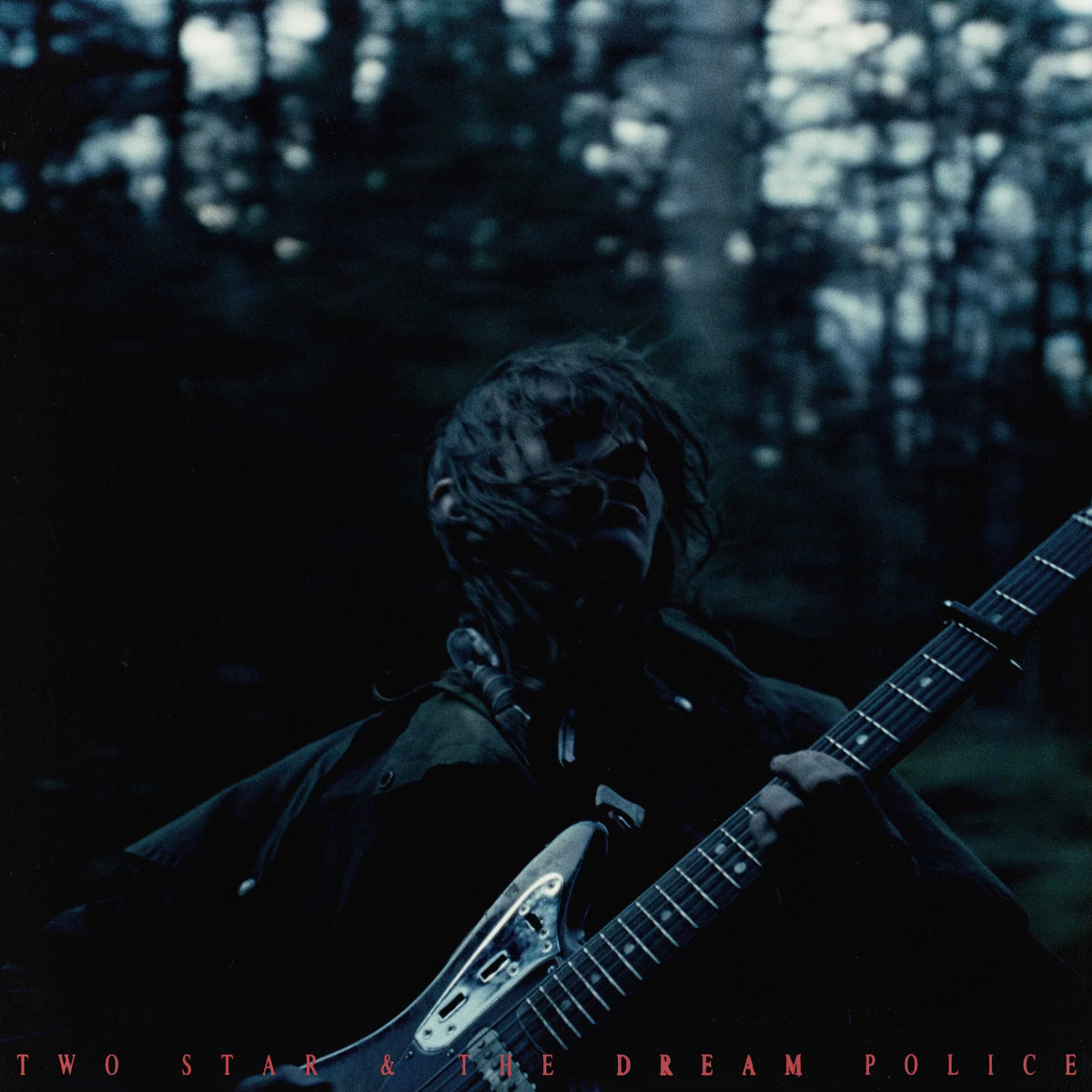
mk.gee—Two Star & the Dream Police
Released February 9, 2024
There’s something serendipitous about listening to this album on the day and the week following its one year anniversary of being out in the world. In the last year, this album has done wonders for its creator, Michael Gordon who goes by the artist name mk.gee (pronounced ma-gee). Gordon has been exalted as the next hero of guitar music, and following the “biggest word-of-mouth success” last year, the album has been featured as no less than in the Top 20 of every major publications Best of 2024 list, being named number one by Clash, Dazed, and The New York Times. Pitchfork even went as far as to name it one of the best albums of the first half of the decade. While I enjoyed the SNL performance Gordon gave in November 2024, in listening to this whole album, I’ve set out to determine if Gordon really is the second-coming of Clapton as he’s been exalted, or if the music media has either set Gordon up for failure.
Gordon started teaching himself guitar at age 11. While in high school, he was in a band with some other students from school, but quickly learned he preferred to play on his own and began making his own demos at home, with himself playing all the instruments. He briefly studied at USC’s Thornton School of Music in LA, but later dropped out. Since then, he’s been a songwriter and producer working with artists Omar Apollo, Kacy Hill, Fred Again, The Kid Laroi, and even had one of his songs “Mountains,” that he co-wrote for Charlotte Day Wilson, sampled by Drake and Travis Scott for their track “Fair Trade” off the Certified Lover Boy album. But the collaboration that has had the most impact on Gordon’s music is the work he’s done with Dijon.
Dijon Duenas is a 32-year-old artist, songwriter, and producer who’s been a frequent collaborator with and influence on Gordon. Gordon co-wrote and co-produced Dijon’s debut record Absolutely which was released in 2021 and the process of the two of them working together was one of mutually beneficial collaboration in which both artists came out stronger for having worked together. Before his work with Dijon, Gordon’s first mixtape A Museum of Contradiction (2020) was called “an important stepping stone” in Gordon’s budding career, despite “sounding like watered-down Tame Impala and Thundercat” with his “natural ability to balance emotional depth with musical complexity” being noted which would appear again on his full-length debut album. Likewise, before he started collaborating with Gordon, Dijon’s “brand of guitar-backed R&B was charming but safe, a collection of Blonde-lite songs that didn’t always extend past emulation.” All of that changed when the two became collaborators, “performing in lock step, feeding off the same life force, which they would soon bring to stages around the world.” Gordon said of their artistic and collaborative relationship, “We were both trying to just find a new wheel to invent, separately, and kind of questioning why nobody else was as feverishly, or embarrassingly, reaching. Then we were both like, let’s see how far we can push each other.” While Gordon offered Dijon “a new rhythmic architecture,” in turn, Dijon was able to influence Gordon, who was once a “tepid vocalist” into belting, cooing, and moaning “with soulful, skin-tingling skill.”
My favorites on the album are “Alesis,” “New Low,” “Are You Looking Up,” “Candy,” and “Dream Police.”
This album really is very good, particularly for a debut. You can tell a lot of years of trial and error, experimenting, and perfecting went into the sound of this record. It’s interesting in a good way, not just when you say something’s interesting for lack of a better, but less polite word. It’s interesting in the sense that it is “as singular as it is familiar, an original and expansive record that feels at once timeless and uncannily contemporary.” You can also tell just from what you can hear, but also from watching his live performances that he’s very technically skilled—so skilled that it looks effortless. Watching both videos of his live performances and his work with Dijon on Absolutely (2021), it looks like the music is coming through him, like the music’s always existed out in the ether somewhere and now it’s coming to us through him. But we know in reality, that a lot of time and work, as well as skill and talent, has gone into Gordon creating this work, not by magic or divine providence, but through good old-fashioned craftsmanship.
Dijon himself has complimented Gordon as a “once-in-a-lifetime guitar player,” but “if you listen to that record just for his amazing guitar playing, you completely missed the whole thing, which is that he might be the most fascinating producer on the planet right now.” Gordon’s work up to now has been entirely self-produced at home, highlighting the incredible mastery he has with his craft to create a style which is “distractingly lo-fi at first, [but] is in fact obsessively intentional, an experiment in contrast and juxtaposition.” Gordon’s approach to producing appears to be much like his approach to guitar playing, both inspired by the fluidity and improvisation of jazz music. He initially first learned the basics of the guitar from an upright bass player, thinking it “would be more useful to learn from someone who didn’t play the guitar at all — someone who could give musical lessons that were more exploratory, more about trying things out,” rather than learn from someone who was trained more traditionally on the guitar. He has since taken this initial instruction and inspiration from jazz to create his own, said to be entirely original, style of instrumentation and has been widely noted for his “technical ability, composition, and creative experimentation.” As seen in the Absolutely film, Gordon’s skill is most apparent in how easy he makes it look. He’s so skilled that he’s never “showing off but playing perfectly to the song and nothing above it.” That’s skill, to know what’s needed and when to hold back.
Another big win for this album is his voice. In my experience of listening to virtuosic instrument players, particularly guitarists, where they excel in technical skill, they lack in vocality or in the songwriting. Here, Gordon is not one such of these artists. Even the lyrics, while perhaps missing a wider, overarching story or message, are still intriguing enough to listen to and try to find a wider narrative. This proclivity for close listening is necessitated not just by the lyrics but also by the ambient production in which the “songs melt together and are mixed in such a way that you could blink and miss their most tender moments.” Listeners have taken this “shyness” in the music “that adds duality to the record” and rewards those who make the effort to listen closely “with something so affirming and relatable” to a level that can only be described as a deep, “borderline-religious devotion as they try to crack Mk.gee’s influences and pedal board setup like riddles.” This performed enigma has been noted as unique in a current moment where fans have been “over-served everything they have ever wanted, often in too-obvious packages,” but Gordon has taught his audience to “value mystery and delayed gratification.” The current moment of fans being fed every little detail like breadcrumbs on a trail is no doubt a reference again to Taylor Swift’s easter-egg-full The Tortured Poets Department in which her fans (and the general public) tried to decipher every clue to uncover the full story. But here’s the thing, how is that different from this? In both instances, fans are closely listening to the music and the lyrics to uncover “clues” that lead to a wider narrative. You can choose whether or not you listen that close, but you might be missing out and real fans, “true” fans, take the time to listen and connect all the pieces to enrich their experience of the album. How are these two things different, except for Taylor Swift is the biggest pop star and that somehow makes her trite and mk.gee is the next savior of guitar-based rock music, and therefore is worth putting that effort into?
In lacking a straightforward narrative, the songs instead share an abstract perspective of loneliness and tension, it also speaks to the larger mystique Gordon is creating around himself and the persona he’s creating of a hero on a journey. Speaking to the New York Times, Gordon himself said the album was “inspired by Jungian archetypes of self-discovery” and follows loosely “chronologically as an abstract hero’s journey,” The hero of our story can be seen emerging in Gordon’s “shadowy performance videos" in which he appears playing “on moving vehicles like some sort of lone train-hopper.” Like Theseus or a knight in King Arthur’s mythology, Gordon “has carefully curated the image of Mk.gee as an enigmatic hero wielding a guitar like a sword.” This mystery and persona surrounding Gordon effectively creates a distance between the creator and the creation, as we’ve seen artists like Chappell Roan and Lady Gaga do. Even the style of his hair, now long and straggly, hanging over his eyes and around his face, concealing his identity, is different from his short, bleached hair in the Dijon short film and creates more distance between the real Gordon, his chosen persona of mk.gee, and the audience. Gordon, through his persona-creation, has also given himself the impression of being alien-like, or something other than human. He said deliberately “I don’t want to be related to…I don’t feel like you at all — I feel like an alien. Why would I make music any other way?” This separation, no doubt, is a protective measure as much as an artistic one. Not only is he setting himself apart from his contemporaries, an aim he has made clear with his comments “I just don’t want to join somebody else’s citadel. I want to build my own thing, my own castle with my friends, because that’s what’s needed,” but we’ve also seen what happens when the public develops a parasocial relationship with musicians, actors, and public figures. Many have before tried to create a distinct public and private life to varying degrees of success, but since the rise of Chappell Roan and her outspokenness about the industry, it may be that we will continue to see artists attempting to carve out for themselves a work-life balance that is often not afforded to them. And so far for their part, fans and critics aren’t taking issue with this separation of church and state in the case of mk.gee. The Guardian noted, “Indeed, in an age when pop songwriting is often as personal and direct as a DM, Mk.gee counters that by bringing back mystery and an inability to be fully understood.”
My one complaint about the album as a whole is that it is a bit same-same throughout, but every once in a while there’s a song that packs a punch. And for me, no song does that more than “Alesis.” This is the first song I heard and that made me want to listen more to mk.gee. For about a month, I only listened to this song and watched both the live video and the SNL performance of it. And now, after hearing the rest of the record, it still feels like the best of what the whole project has to offer. Despite it being the only song from the album to be played at the SNL performance (the other song being an unreleased one called “Rockman,”) it wasn’t a single and seemed overlooked in other reviews in favor of “Are You Looking Up” and “How many miles.” But that didn’t stop it from ending on the year-end Best-of lists of publications Coup De Main and Vulture, who named it their number one, and NME, The Ringer, Billboard, Paste, and Uproxx featuring it amongst their 100 best of 2024.
A wide range of genres and influences has been thrown around to describe Gordon’s sound. His genre has described as “indie, alternative, lo-fi, experimental indie, R&B, and soft-psychedelia," but for his money, all Gordon is trying to make is pop music. Albeit, his own version of pop music as he deliberately tries to reinvent the wheel and make music that sounds like what he thinks pop music should be.
As an artist who “looks up at constellations of classic influences and fires himself somewhere in the middle of them,” his influences include all the guitar greats—Clapton, Hendrix, Prince, Sly Stone. Clairo, who spent some time touring with both Gordon and Dijon, said of Gordon, “I think he’s really special in the way that he synthesizes his inspirations.” But no more has his influence been summed up than as “an 80s historian with an eye for Americana.” Comparisons have been made to “’80s R&B ballads, Phil Collins-inspired downtempo anthems, Michael Jackson-meets-Arthur Russell pop-rock grooves,” "Prince-indebted singing,” influences from “Free Fallin’” and “Every Breath You Take,” even his newest single “Rockman” is said to have a “1975-ish groove.” The 1975 themselves, as well as the whole of pop music for the last 15 years has been built on the sound and nostalgia for ‘80s pop, so as much as Gordon may want to reinvent the way pop music sounds, he can’t escape the past.
I didn’t initially, but I finally started to hear that ‘80s pop influence on “You Got It” and “Candy.” But I also heard a certain ‘90s sound that brought to mind Scottish band Del Amitri and their song “Roll to Me” on “Are You Looking Up.”
This sonic reminder of Del Amitri may not be far off base as Gordon has been a fan of fellow Scottish band The Blue Nile. When Joshua Minsoo Kim for Rolling Stone called one of the tracks “in the lineage of the Blue Nile”, I didn’t initially understand the comparison. But when fellow musician Clario told a story to Joe Coscarelli for the New York Times about Gordon playing the Blue Nile’s song “Saturday Night” for her one night on tour together, it made sense then that Gordon wasn’t making music that sounds like The Blue Nile, but is instead creating a sonic and atmospheric soundtrack in a similar way that The Blue Nile did on Hats (1989).
Even more interesting than Gordon’s deep study of pop music is just how much he is equally indebted to jazz music. In addition to his learning guitar from an upright bass player, Gordon has believed since he was a teenager that “Jazz is something that has a little more soul.” And just like how in jazz the recordings are snapshots of the live performances, Gordon’s varied performances between the album recording, the filmed live performances, and the live television performances show an emphasis on the live performance over the studio recording.
If you were only to go by what’s been written about this album from other music critics, you’d think it’s the greatest thing since sliced bread. Gordon’s been said to have written “new blueprints for musical architecture,” and the album is said to “carry the weight of an artistry so well studied and expertly executed.” By saying his “orchestration is purposefully hard to follow,” makes it hard for even himself to follow. For a debut album to get reactions like this, it makes clear that Gordon has no where to go as an artist.
Without a doubt, what Gordon does on this album is impressive. His clear artistry and technical expertise, as well as the simultaneous new and familiar feeling it has, makes it an incredibly enjoyable listen. The fact, too, that in an age of increasing reliance on AI, and a “moment where young people are connecting to ‘real people behind real instruments,’” as Clairo said to the New York Times, he is bringing back to the front of popular music a focus on real skill in playing, and a focus on being able to play live what you play in the studio. But my fear is that we’ve (read: music critics) have created a situation where Gordon is set up for failure on his next release, or at the very least we have set ourselves up for disappointment. As I’ve written about before, particularly in terms of Kacey Musgraves’ post-Golden Hour releases, we have to allow room for artists to grow and evolve. We can’t expect every album of their career to be a rehashing of their best or their most popular work. And even if they did do that, we still wouldn’t be happy and we’d be complaining that they’re resting on their laurels or phoning it in and aren’t actually innovating within their own sound. So no matter what Gordon does next as mk.gee, whether he makes another album exactly like this one, or goes completely in another direction, the reviewers are never going to be as happy with him as they are right now. And for an artist who’s just now debuting his own music, it has to really suck to know that your best work is already behind you, at least in the eyes of the public. So, at the risk of sounding like a broken record, I will say it again: let artists change and grow and experiment. This album isn’t going anywhere, you can always come back and listen to it. But at least give mk.gee a chance to surprise you with his next release.
Emma! knew what your critique would be the moment I saw the title. 🙉 the buzz Mk.Gee has stirred within the “alt-mainstream” crowd is unlike anything I’ve seen in years. that said, I’d be a hypocrite not to acknowledge my near-religious devotion this past year.
from the interviews he has given, I have a hunch he's a bit more self-aware than artists in the likes of Jai Paul and Frank as to the magnitude of what he was doing when developing Two Star. this makes me think that his likelihood of getting paralyzed over his success should be lower.
fans (source: the Mk.Gee subreddit) have been highly receptive to Lonely Fight and ROCKMAN, released post-album. it could simply be that, objectively, they match the album’s quality — had that not been the case, we might’ve seen a situation like the Kacey Musgraves fallout you mentioned (which, again, guilty as charged).
sorry for the rant, but you really plucked a string on me! haahahah